
Soft Wash vs. Pressure Wash: What's the Difference, and Which Does Your Home Need?
Columbia Exterior Cleaning
Local exterior-cleaning crew ·
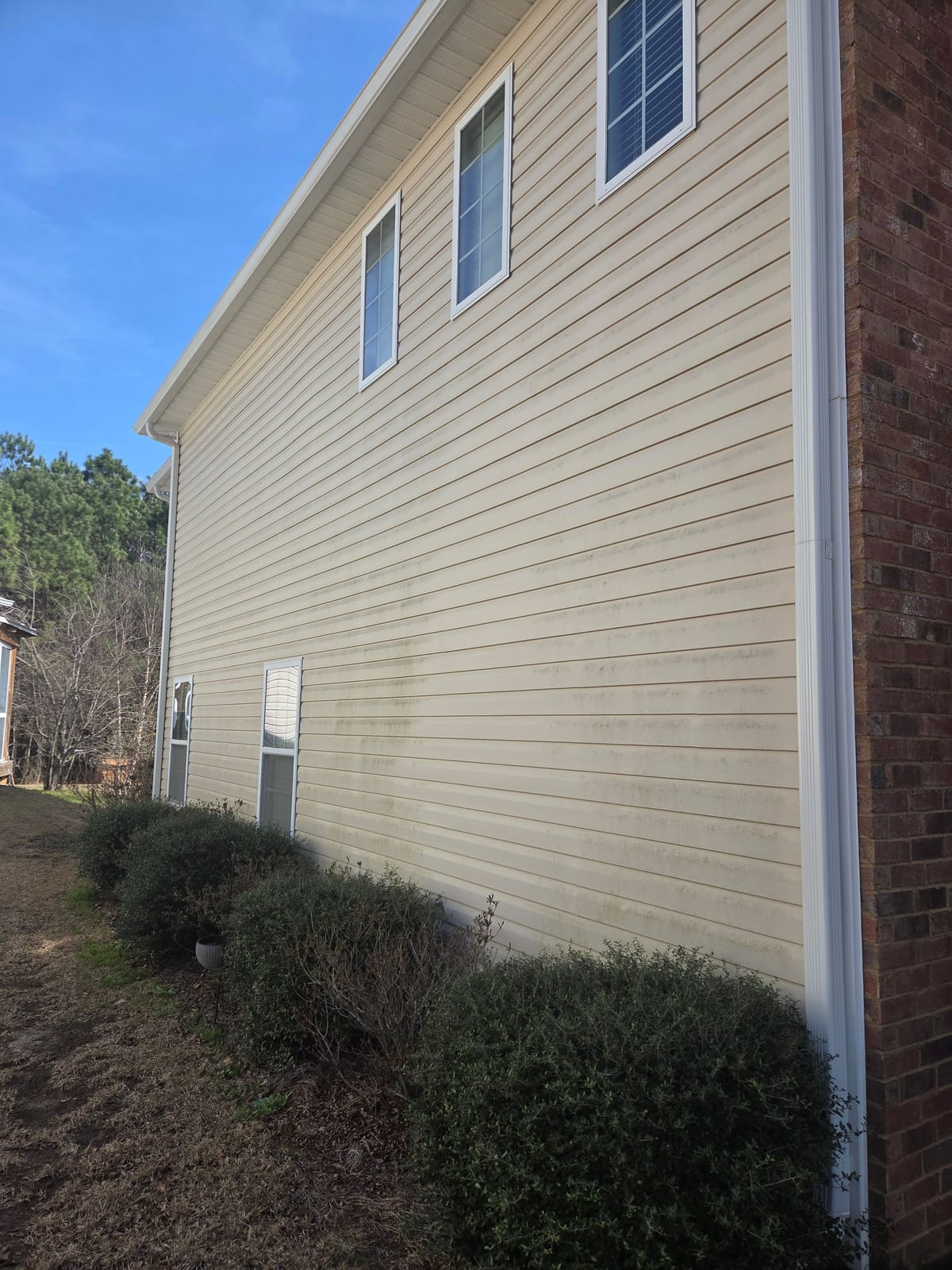
The difference comes down to force versus chemistry. Pressure washing removes dirt and growth by blasting it off with high-PSI water. Soft washing removes it with a biodegradable cleaning solution applied at roughly garden-hose pressure — the solution does the work, not the water pressure. Which one your home needs depends entirely on the surface, and using the wrong method on the wrong surface is the single most common way homeowners end up with damage or a job that has to be redone within months.
Pressure Washing: When Force Is the Right Tool
High-pressure water is the correct method for hard, non-porous surfaces that can take the impact without damage — concrete driveways, sidewalks, brick pavers, and other flatwork. A rotating surface cleaner attachment lifts dirt and staining evenly across a slab without the streaky "zebra stripe" pattern a wand alone tends to leave. This is the method behind our driveway and concrete cleaning service.
Soft Washing: When Chemistry Is the Right Tool
Anything porous, painted, or biologically alive needs soft washing instead:
- Vinyl, wood, or fiber-cement siding — high pressure can force water behind panels and trim, leading to mold growth you can't see until it's already a problem.
- Stucco — porous by design, and pressure washing drives water into the surface rather than off it.
- Roofs (shingle, metal, or tile) — high pressure strips protective granules off asphalt shingles and can lift shingle edges. See our full explanation in Roof Cleaning Without Pressure Washing.
- Screens and painted or older wood trim — thin, fragile materials that pressure alone can tear or chip.
- Anything with active algae, mildew, or lichen — these are living organisms. Blasting them off the surface removes the visible growth but leaves the roots intact, and they're back within a season.
Why the Wrong Method Backfires in Columbia's Climate
Columbia's humid subtropical climate is exactly the environment algae and mildew thrive in — heat, humidity, and heavy oak and pine canopy keep north-facing and shaded walls damp for long stretches most of the year. That's the same growth homeowners see as black or green streaking, most often on the shaded side of the house or on roofs (commonly Gloeocapsa magma, the algae responsible for the dark streaking on asphalt shingles across the Southeast).
Pressure-blasting that growth off feels satisfying in the moment, but because the roots survive, it comes back — often within a few months, faster on shaded elevations and anything near open water like Lake Murray. Soft washing kills the organism at the root, which is why the results last a full season or more instead of a few weeks.
Quick Reference: Which Method for Which Surface
| Surface | Correct Method |
|---|---|
| Concrete driveways, sidewalks, patios | Pressure wash (surface cleaner) |
| Vinyl, wood, or fiber-cement siding | Soft wash |
| Stucco and brick facades | Soft wash |
| Roofs — shingle, metal, tile | Soft wash only, never high pressure |
| Wood decks and fences | Pressure dialed down to the material — see our deck cleaning guide |
| Windows and screens | Low-pressure hand detail / pure-water system |
The Method Question Every Homeowner Should Ask a Quote
Before hiring anyone, ask what method they'll use on your siding and roof. If the answer is "pressure washing" for either, that's worth a second opinion — both surfaces should be soft-washed. A company that quotes one flat pressure setting for the entire house, regardless of surface, is optimizing for speed, not for your home's finish or your paint warranty.
Common Myths Worth Clearing Up
"Higher Pressure Means a Better Clean"
Not on a living surface. Algae and mildew are organisms, not stains — the question isn't how hard you can hit them, it's whether you kill the root structure. A low-pressure soft wash that kills the organism outperforms a high-pressure blast that only knocks the visible layer loose, every time, because the blast job is back within weeks and the soft-washed surface holds for a season or more.
"Soft Washing Is Just a Weaker Version of Pressure Washing"
It's a different tool for a different job, not a downgrade. A surface cleaner attachment on a driveway and a soft-wash sprayer on siding aren't points on the same scale — they're built to solve different problems. Pressure lifts embedded grime out of a hard, non-porous surface. Chemistry kills biological growth on a porous or fragile one. Neither method is "better" in general; each is correct for specific surfaces.
"Windows Get the Same Treatment as Siding"
Windows are their own category entirely — glass gets a pure-water, low-pressure hand-detail approach rather than either driveway-style pressure or the algae-killing chemistry used on siding and roofs, since the goal there is a spot-free finish, not killing growth. See our window cleaning service for that method.
What This Means for Your Quote
Because the correct method varies by surface, a thorough quote should account for siding, roof, driveway, deck, and fence separately, even if they're all handled in one visit. If every surface on a quote gets the exact same price-per-square-foot regardless of material, ask what method is actually being used — it's a sign the company may be defaulting to one pressure setting for everything rather than treating each surface correctly. Our full Columbia, SC pricing guide breaks down what a properly method-matched quote typically looks like.
How We Approach It
Every visit treats each surface with the setting it actually needs — pressure on the driveway, chemistry everywhere else, and a dedicated pure-water pass for glass. That's the difference between a company that owns a pressure washer and a company that treats exterior cleaning as a method, not just a machine.
Not sure which your home needs? Call or text (803) 717-3217 for a free assessment, or explore our house washing (soft wash) and pressure washing services to see the full method breakdown by surface.
Frequently Asked Questions
What's the actual difference between soft washing and pressure washing?
Pressure washing removes dirt with force — high-PSI water physically blasts material off a surface. Soft washing removes it with chemistry, applied at roughly garden-hose pressure. Anything alive, like algae, mildew, or lichen, needs to be killed rather than blasted off, or it regrows within months. Anything porous or fragile — siding, stucco, screens, older painted wood — can be damaged by high pressure. The right approach uses pressure on hard flatwork like concrete, and soft washing on almost everything else.
Can soft washing damage my plants or landscaping?
Not when it's done correctly. Every bed, shrub, and lawn edge in the work zone should be saturated with plain water before cleaning starts and rinsed again once the work is finished. That two-step saturate-and-rinse process is standard practice and protects landscaping from the cleaning solution.
How long do soft wash results last in Columbia, SC?
Soft-washed house exteriors typically hold up 12–18 months before algae or mildew becomes visible again. Decks, fences, and concrete generally run closer to 12 months. Heavily shaded, north-facing walls and anything near open water — Lake Murray docks and lakefront decks, for example — tend to regrow fastest.
Prefer to talk? Same-day answers — open 7 days, 7am–8pm.
(803) 717-3217Ready to Protect Your Home?
Free quotes, same-day response. Serving Columbia and the SC Midlands (Richland & Lexington counties).